Starship Technologies and Just Eat announce ground-breaking partnership in major expansion of robot delivery
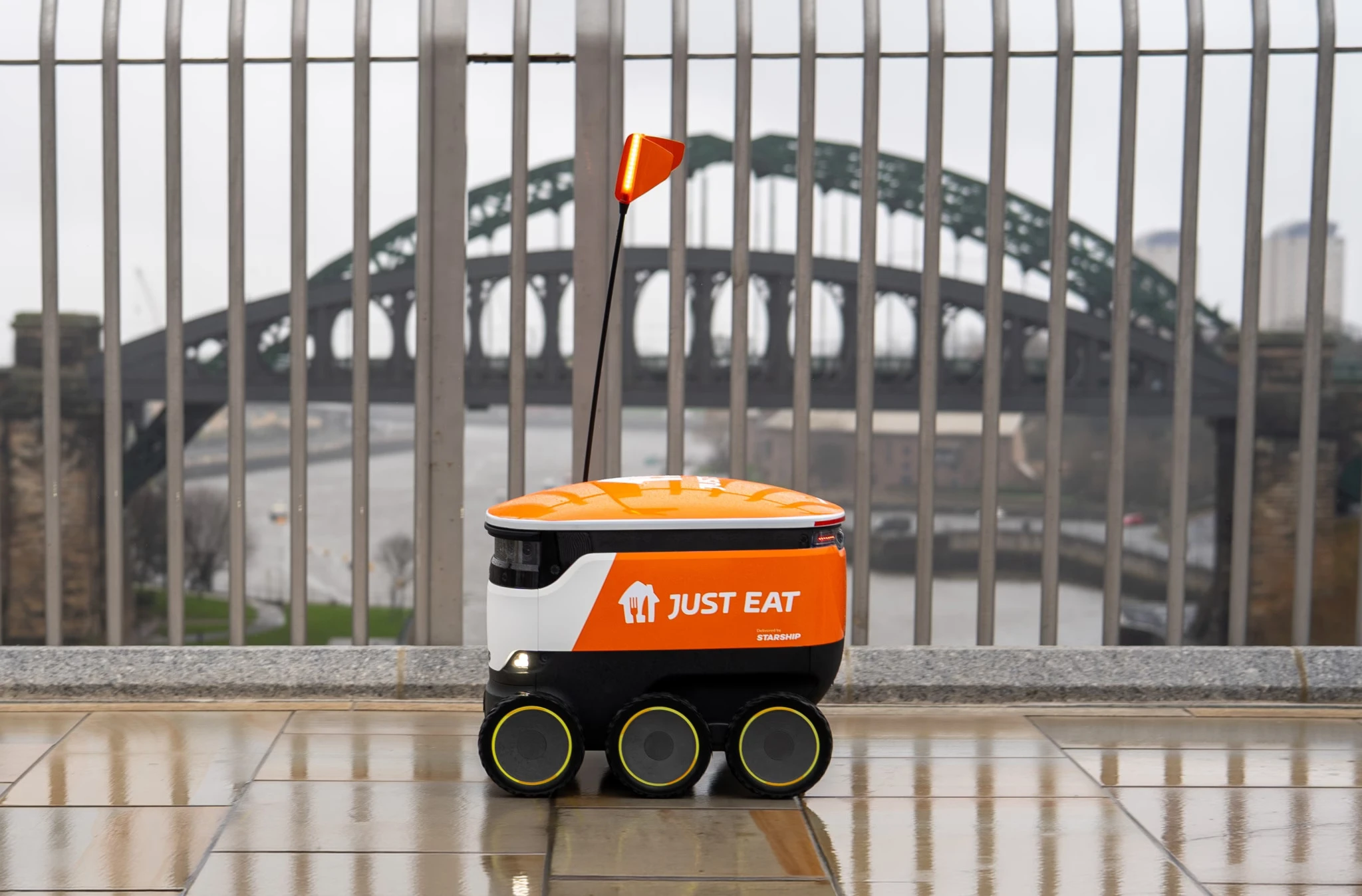
Starship Technologies and Just Eat have announced a landmark corporate partnership aimed at expanding autonomous food delivery services.
Under the agreement, Starship’s autonomous robots will be used to deliver hot meals from local takeaways. The first service launched through the partnership will operate in Sunderland—the home of Just Eat’s operations in the North East of United Kingdom. After the launch, customers will be able to select robot delivery through the Just Eat app. Both companies say the service will scale based on customer demand and is expected to expand to additional locations across the country. The new robots will join hundreds already operating across the UK as part of Starship’s global fleet.
Just Eat moved its customer service hub to Sunderland in 2021. Independent analysis by the Centre for Economic and Business Research estimates that the company’s presence has since contributed £20.8 million to the local economy, with a further £31.7 million generated through supply chains and employee spending.
Demonstrating its long-term commitment to the city, Just Eat signed a ten-year lease in January for new premises in the Riverside area.
Founded in 2014, Starship Technologies is widely recognized as a global leader in autonomous delivery. The company operates more than 2,700 robots across 270 locations in eight countries and pioneered the world’s first delivery robot. To date, its robots have completed over nine million deliveries.
Starship began operating in the UK in 2018 and currently serves customers in cities including Leeds, Wakefield, Greater Manchester, Cambridgeshire, Northamptonshire, and Milton Keynes.
The company’s robots feature industry-leading Level 4 autonomy, allowing them to operate without human intervention 99 percent of the time. According to Starship, this capability makes the robots both highly safe and cost-efficient within the rapidly expanding autonomous delivery sector.
A report by Prysm Global indicates that wider adoption of Personal Delivery Devices (PDDs) in the UK could contribute up to £1.3 billion to the economy by 2035. The report also suggests that manufacturing Starship’s robots in the UK could create around 555 high-skilled jobs and increase grocery spending by £125 million over the same period.
Mert Öztekin, Chief Technology Officer at Just Eat said: “We’re always innovating to improve the delivery experience for our customers and we’re excited to have kick-started our ground robotics trial in the North East with Starship. We’ve teamed up with a diverse range of local independent restaurants to trial the Starship robots and we’ll be listening to their feedback closely, as well as that of our customers.
Ahti Heinla, Founder and Chief Executive at Starship Technologies, said: “We’re excited to announce a new partnership with Just Eat, and to kick it off in Sunderland.
“The key to a scaled, loved delivery service is high-level autonomy. Our robots are trained to think for themselves and learn their way around the local area with ease. The economics of robot delivery only work when the robots are truly smart: robots learn with every journey, and Starship robots have completed millions of journeys.
“But it’s more than that. The autonomy level of our robots means they integrate well into the community. They’re not just able to operate safely. They’re polite – and that’s what builds a genuine connection in the community.
“That’s why tens of thousands of people across the country now get their Friday night takeaways delivered by robots. That’s how Starship is scaling and leading the way.
“We expect our partnership to expand rapidly to other towns and cities across the UK and beyond.”
Patrick Melia, Chief Executive, Sunderland City Council said: “Sunderland is already one of the UK’s most tech-forward and smart cities – and it’s great to have a major local employer like Just Eat involved in this latest innovation. We’re sure these robots will bring extra convenience for residents, especially people who are less mobile or unable to leave home. We look forward to seeing them supporting residents across Sunderland.”