NVIDIA Releases Vera Rubin DSX AI Factory Reference Design and Omniverse DSX Digital Twin Blueprint With Broad Industry Support
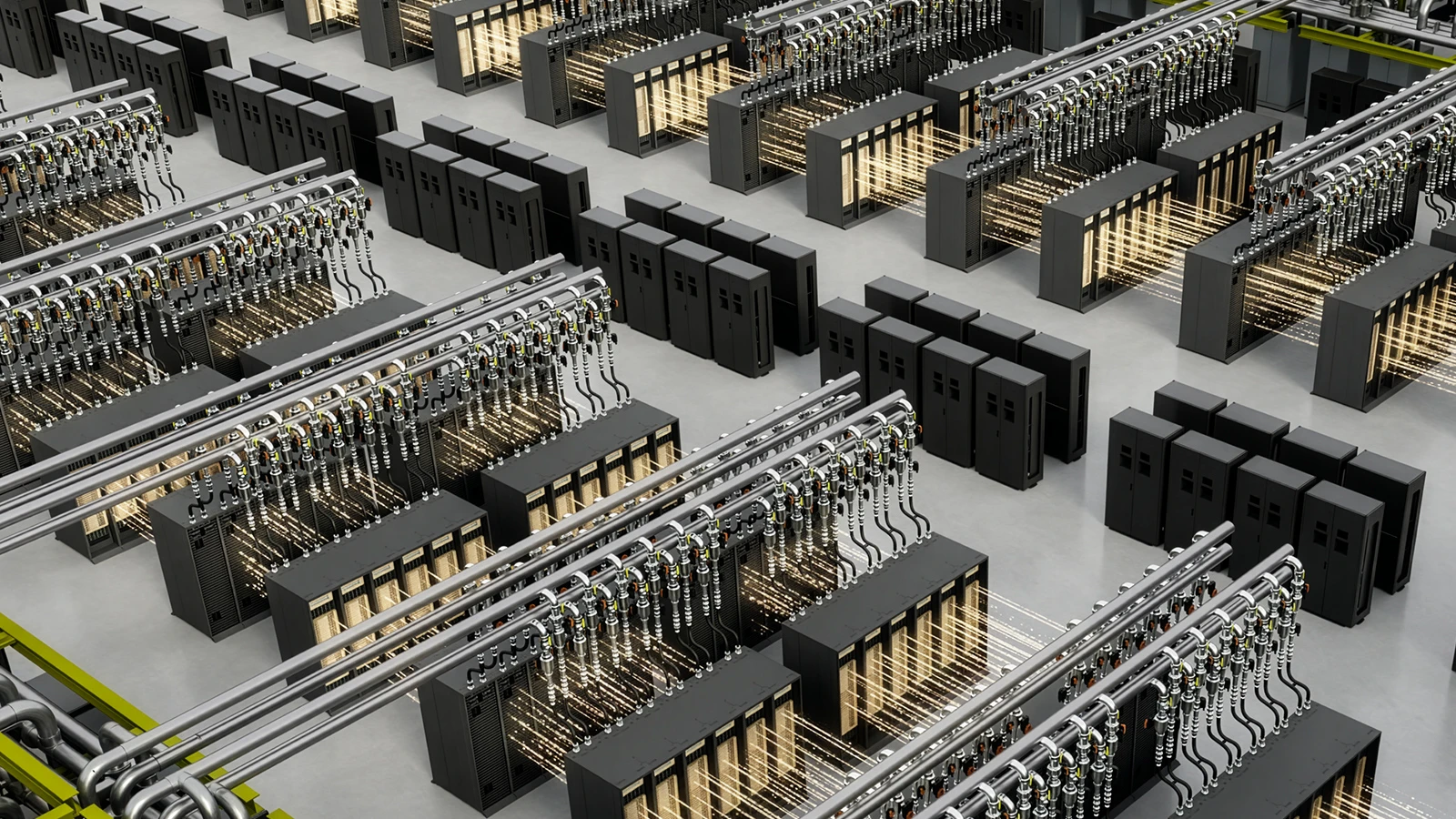
NVIDIA has announced the NVIDIA Vera Rubin DSX AI Factory reference design, a framework for developing co-designed AI infrastructure. The company also revealed the general availability of the NVIDIA Omniverse DSX Blueprint, which is fully compatible with the Vera Rubin DSX platform and enables the creation of physically accurate digital twins of AI factories for large-scale design, construction and operational management.
A range of industry leaders — including Cadence, Dassault Systèmes, Eaton, Jacobs, Nscale, Phaidra, Procore, PTC, Schneider Electric, Siemens, Switch, Trane Technologies, and Vertiv — are contributing to the reference design and blueprint, helping organizations plan, build and manage large-scale AI factory developments.
“In the age of AI, intelligence tokens are the new currency, and AI factories are the infrastructure that generates them,” said Jensen Huang, founder and CEO of NVIDIA. “With the NVIDIA Vera Rubin DSX AI Factory reference design and Omniverse DSX Blueprint, we are providing the foundation to build the world’s most productive AI factories, accelerating time to first revenue and maximizing scale and energy efficiency.”
Building AI Factories That Maximize Every Watt
Developing large-scale AI factories to meet the growing demand for AI training and inference is a complex task that requires precise coordination across multiple elements, including infrastructure, power, cooling, networking, software and compute systems.
The NVIDIA Vera Rubin DSX AI Factory reference design provides a framework for designing, building and operating the full AI factory infrastructure stack. This includes compute systems, NVIDIA Spectrum-X™ Ethernet networking, and storage, helping organizations achieve repeatable, scalable and high-performance AI clusters. The documentation within the reference design also offers industry partners best practices for planning and managing power, cooling and control systems, enabling seamless integration between hardware and software while supporting scalable deployments.
The Vera Rubin DSX software stack is designed to be open, modular and composable, linking cluster hardware with power and cooling systems to maximize AI performance per watt of available energy. Its flexible architecture allows AI factory developers and data center providers to deploy only the components required for their specific needs.
Rubin DSX offers a collection of software libraries for partners to build on:
- DSX Max-Q helps AI factories and ecosystem partners maximize computing output and token performance per watt on NVIDIA systems within a fixed power budget.
- DSX Flex connects AI factories to power-grid services, enabling them to dynamically adjust power use and orchestrate demand with hybrid onsite generation to save energy and maintain grid stability.
- DSX Exchange enables scalable and secure integration of compute, network, energy, power and cooling plant signals between IT, operational technology and operations agents.
- DSX Sim models validate AI factories as high-fidelity digital twins, using the NVIDIA DSX Air platform to model GPUs, networking and partner infrastructure, and DSX SimReady connects detailed 3D geometry, logistics and system behavior — accelerating time to first revenue and ensuring day-one performance.
Accelerating AI Factory Design and Simulation
Even with a detailed architectural framework, designing, building and operating large-scale AI factories remains a complex undertaking. Traditional design approaches often struggle to model entire systems accurately, optimize power efficiency, and validate infrastructure before construction begins.
The NVIDIA Omniverse DSX Blueprint addresses these challenges by providing an open and comprehensive framework for the design and operation of AI factories at scale. Now generally available on build.nvidia.com and fully compatible with the NVIDIA Vera Rubin DSX AI Factory reference design, the blueprint enables developers to create physically accurate digital twins of AI factories. These digital environments allow teams to simulate operations in real time and optimize performance before deployment or construction starts.
By integrating power, cooling, networking and operational systems within a unified environment, Omniverse DSX helps accelerate time to revenue while improving AI efficiency. Using NVIDIA Omniverse™ libraries, organizations can simulate facility layouts, power architectures, thermal dynamics and operational policies. This also allows them to test hardware changes or workload adjustments without disrupting live production systems.
Industry Leaders Adopt the Reference Design and Blueprint
Reliable and scalable power and cooling systems form the foundation of AI factories, enabling intelligent infrastructure to adapt to fluctuating compute demands while maintaining efficiency and uptime. A broad ecosystem of industry partners — spanning energy, infrastructure and software — is adopting DSX technologies to transform the entire AI factory lifecycle into a coordinated, product-level system designed for resilience, precision and operational efficiency.
Dassault Systèmes is incorporating the new reference design and blueprint into its Model-Based Systems Engineering platform powered by CATIA software, creating a Virtual Twin of AI Factory that can accelerate time to first revenue while improving operational reliability and efficiency. Schneider Electric, meanwhile, is integrating its ETAP platform to support simulation and optimization of power distribution systems.
Cadence is integrating simulation-ready (SimReady) models of the NVIDIA GB300 NVL72 system into its Reality Data Center Digital Twin Platform to simulate thermal and fluid dynamics for optimized AI factory design and operations, while also collaborating to model NVIDIA Vera Rubin systems. Siemens is developing a framework that balances high-density computing with power management, cooling and automation for AI infrastructure.
Jacobs has developed a Data Center Digital Twin solution based on the Omniverse DSX Blueprint, offering digital twin capabilities that help builders and operators optimize AI factories from planning and design through construction and ongoing operations. PTC is integrating the blueprint into its Windchill product lifecycle management solution for DSX Accelerator, linking engineering and product design data with high-fidelity, real-time simulations while managing bills of materials across partners and suppliers. Procore is incorporating NVIDIA Omniverse libraries and the DSX Blueprint into the Procore Platform to create a continuous digital thread throughout the construction lifecycle.
Switch is using the Omniverse DSX Blueprint to develop its EVO AI Factories and LDC EVO operating system, enabling real-time telemetry ingestion, continuously updated digital twins aligned with Rubin DSX reference specifications, and automated optimization of power, cooling and workload distribution. Meanwhile, Nscale and Caterpillar are implementing Vera Rubin DSX reference designs at a multi-gigawatt site in West Virginia, which is expected to become one of the world’s largest AI factories.
CoreWeave is leveraging NVIDIA DSX Air to build and test digital twins of AI factories in the cloud, significantly shortening validation timelines by conducting operational simulations well ahead of physical deployment.
NVIDIA’s broader partner ecosystem also provides SimReady assets representing equipment and infrastructure components, allowing AI factory operators to simulate and refine entire facility designs before real-world implementation. Companies including Eaton, Schneider Electric, Siemens, Trane Technologies and Vertiv are contributing SimReady models of generators, electrical equipment and cooling systems to help engineering teams validate designs during the planning stage.
Additionally, Vertiv is using the Omniverse DSX Blueprint to develop Vertiv OneCore Rubin DSX, a prefabricated, converged data center infrastructure solution designed to accelerate AI factory deployment while maximizing AI output per watt of power consumed. Trane Technologies is applying the blueprint to optimize thermal management for gigawatt-scale AI factories, helping reduce cooling plant power consumption and improve efficiency.
Finally, Phaidra has integrated DSX Max-Q into its new self-learning AI agent, enabling up to 10% more compute capacity by reducing cooling spikes, maintaining operational safety and freeing up additional power for revenue-generating AI workloads.
Global Energy Leaders Modernize Power Grids With Omniverse DSX Blueprint
To address this, NVIDIA is working with leading energy providers to unlock faster access to power and strengthen grid stability:
- Emerald AI is integrating DSX Flex with its Conductor platform to help AI factories manage power in real time — turning demand up or down on command and coordinating flexible load with new dedicated generation — giving utilities greater confidence to approve larger, faster grid connections through reliable, software-based load control.
- GE Vernova is extending digital twin capabilities across the power stack from grid to AI factories — aligning with NVIDIA DSX reference architecture to unify power and compute modeling for faster, more accurate and predictable infrastructure deployment for large-scale AI factories.
- Hitachi is partnering with NVIDIA to accelerate grid planning and deliver efficient, reliable power for gigawatt-scale AI factories, combining physical AI, power systems and automation expertise with advanced computing platforms.
- Siemens Energy is using NVIDIA RAPIDS™ libraries, the NVIDIA Metropolis platform and the NVIDIA Isaac Sim™ framework in its Noedra digital twin platform to monitor grid health in real time, helping predict risks before failure and reduce unplanned outages.