NVIDIA Announces BioNeMo Agent Toolkit — Tools for Agents to Accelerate Scientific Discovery
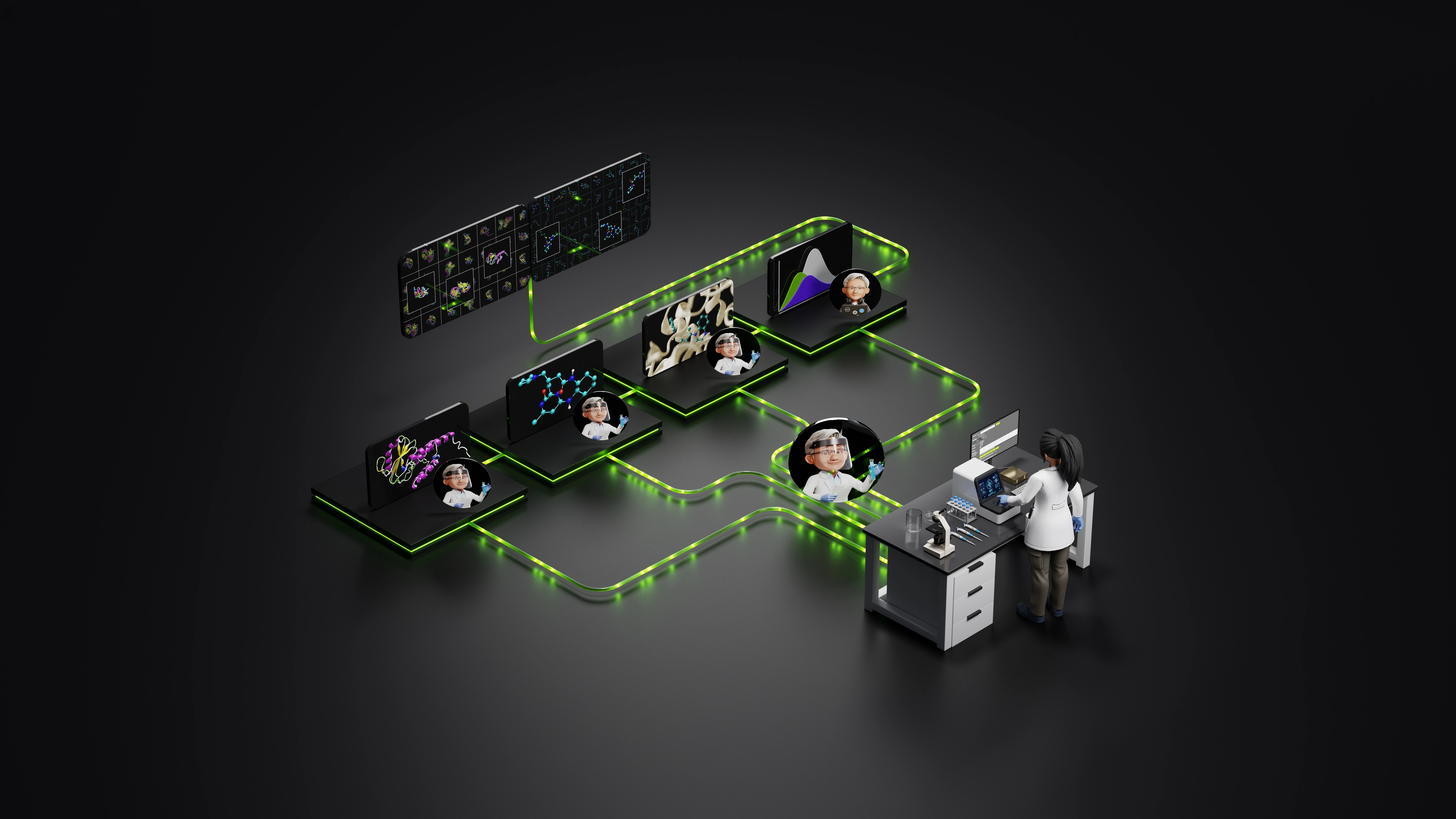
NVIDIA has announced the launch of the NVIDIA BioNeMo Agent Toolkit, a suite of domain-specific tools and capabilities designed to support the emerging era of agentic life sciences.
Built on more than a decade of NVIDIA’s life sciences libraries, tools, and open models, the toolkit enables AI agents, researchers, and laboratories to collaborate more effectively by collecting evidence, reasoning across scientific findings, running computational experiments, and suggesting next steps to accelerate discovery.
The platform equips a wide range of AI systems — from general-purpose assistants to specialized scientific agents and enterprise biopharma platforms — with the ability to synthesize and summarize scientific knowledge, invoke models, evaluate outputs, and execute subsequent actions.
NVIDIA BioNeMo, integrated within the toolkit, is powered by NVIDIA NIM microservices, NVIDIA Parabricks, NVIDIA NeMo, and NVIDIA Nemotron technologies, alongside accelerated computing capabilities, providing an open and trusted foundation for agent-driven life sciences workflows.
More than 50 leading companies are already adopting the toolkit to advance research and discovery, leveraging agent-enabled capabilities for applications such as protein structure prediction, molecular docking, generative chemistry, genomic analysis, protein design, and biomarker identification.
“Frontier models are the brains. BioNeMo is the scientific toolbox. Together, they give AI agents the skills of a PhD research assistant and the speed of a supercomputer,” said Jensen Huang, founder and CEO of NVIDIA. “For the first time, researchers can build AI agents that understand scientific knowledge, use scientific tools and execute scientific workflows. This is a new way to do science — one that can dramatically accelerate discovery across biology, chemistry, genomics and medicine.”
Open model and research organizations, including the Arc Institute, the Open Molecular Software Foundation, and the University of Washington’s Institute for Protein Design (IPD), are collaborating with NVIDIA to leverage BioNeMo in advancing frontier AI models and improving their accessibility through agent-ready workflows. As part of this collaboration, the IPD has helped accelerate the runtime of state-of-the-art biodesign models such as RoseTTAFold3, achieving performance improvements of up to 2x compared to previous-generation implementations. Additional applications are also being developed to further support protein design research, enabling scientists to operate at a scale and cost previously unattainable.
“Every tool we’ve built for protein design is only as powerful as the scientists who can efficiently access it,” said David Baker, professor of biochemistry at the University of Washington School of Medicine and director of the Institute for Protein Design. “The next leap in science won’t come from a single discovery; it will come from the speed of iterative designs and agents that can repeatedly reason through the complexity of biology at a speed humans never could.”
Agent-Ready Tools and Skills for Life Sciences
Life sciences represents one of the most critical frontiers in global research, with worldwide R&D investment reaching approximately $3.8 trillion and annual pharmaceutical spending nearing $300 billion.
In this context, agentic workflows offer a way for the industry to accelerate iteration cycles, reduce costs, and improve the likelihood of successful outcomes. By enabling general-purpose AI agents to be converted into life sciences–specific agents within minutes, the BioNeMo Agent Toolkit allows researchers to run experiments more efficiently, continuously learn from results, and close the loop between hypothesis generation and scientific discovery. In some cases, this iterative process is being extended directly into physical laboratory environments.
Traditional general-purpose agents often struggle with complex scientific workflows, as they must infer appropriate tools, inputs, outputs, and domain-specific biological meaning. In contrast, the BioNeMo Agent Toolkit enables agents to directly access the right tools, interpret results more accurately, and generate scientific insights more quickly and reliably.
NVIDIA is further enhancing the BioNeMo ecosystem by transforming its libraries, models, and frameworks into agent-callable components. This includes leveraging technologies such as NVIDIA Nemotron open models for reasoning foundations, the NVIDIA NeMo RL library for reinforcement learning, and NVIDIA NemoClaw blueprints for building secure, private agents capable of multi-step reasoning, tool usage, and continuous data interaction.
Additionally, NVIDIA NIM microservices allow agents to seamlessly invoke models and execute tasks, while the NVIDIA OpenShell runtime provides a controlled and secure execution environment for computational workflows.
The toolkit’s components enable agents to complete workflows such as:
- Virtual Screening: Agents can help researchers identify small-molecule drug candidates by generating and screening compounds, docking them to a target, predicting binding strength and filtering for drug-like properties. Then, the agent can output which candidates should be prioritized, compressing screening timelines from days to minutes.
- Genomic Analysis and Target Discovery: Agents can help researchers transform raw sequencing data into prioritized genetic insights and biological targets. NVIDIA Parabricks accelerates alignment and variant calling, while genomic foundation models score variant effects and the agent ranks the most disease-relevant candidates for further study.
- Protein Binder Design: Agents can help researchers design and validate candidates computationally before work begins, compressing traditionally labor-intensive design work.
- Deep Biomedical Research: Agents connect real-world data to reasoning models to improve the efficiency and accuracy of various scientific and clinical development processes, including literature review, protocol generation, clinical trial screening and pharmacovigilance with the NVIDIA Biomedical AI-Q Research Agent.
- Medical Imaging Analysis: Agents can help researchers process, segment, synthesize and reason over medical imaging data to support biomarker discovery, accelerating evidence generation across research workflows.
Life Sciences Ecosystem Builds With NVIDIA BioNeMo
A broad range of companies across the technology and life sciences ecosystem are adopting the BioNeMo Agent Toolkit to accelerate the development of agentic workflows.
Leading frontier AI labs and scientific agent developers, including Anthropic, Edison Scientific, Lila Sciences, OpenAI, and Owkin, are integrating BioNeMo to enable agents to move beyond answering questions and toward executing end-to-end scientific tasks. NVIDIA-accelerated models and analysis libraries further reduce the time required to translate hypotheses into actionable insights.
Scientific data and workflow platforms such as Benchling, Certara, Databricks, Snowflake, and Seqera are leveraging the toolkit to connect complex data systems with AI-driven research workflows. BioNeMo-enabled skills allow agents to query biological and chemical datasets, prepare model-ready inputs, execute reproducible pipelines, analyze results, and deliver insights directly within the platforms used by scientists and data teams.
In diagnostics and pharmaceutical research, companies including Lilly and Natera are applying BioNeMo Agent Toolkit capabilities to scale repeatable agentic workflows across drug discovery, translational research, and clinical insight generation.
AI-native biotechnology firms such as Boltz, Basecamp Research, Chai Discovery, Dyno, PerturbAI, and Proxima are collaborating with NVIDIA to develop tools that accelerate model-driven therapeutic design and biological research workflows.
Computer-aided drug discovery providers, including Dassault Systèmes, Cadence (OpenEye), and Schrödinger, are integrating BioNeMo capabilities into their scientific software platforms. These integrations enable agents to orchestrate molecular generation, docking, and prediction workflows, transforming traditional discovery tools into interactive systems where researchers can query models, run analyses, and identify next steps more efficiently.
In addition, laboratory instrumentation and automation companies such as Automata, HighRes, Tecan, Thermo Fisher, and the autonomous data generation platform Medra are connecting physical laboratory systems with computational discovery enabled by BioNeMo skills.
Finally, AI cloud and infrastructure providers including Baseten, Modal, and Nebius are utilizing the toolkit to help operationalize life sciences workflows as scalable, production-ready services. By exposing BioNeMo skills through APIs, managed compute, and inference environments, these platforms help transition agentic biology applications from experimental prototypes to accessible enterprise-grade solutions for researchers worldwide.
Availability
BioNeMo Agent Toolkit and skills are available now through the NVIDIA developer resources page and GitHub.