NVIDIA and Global Robotics Leaders Take Physical AI to the Real World
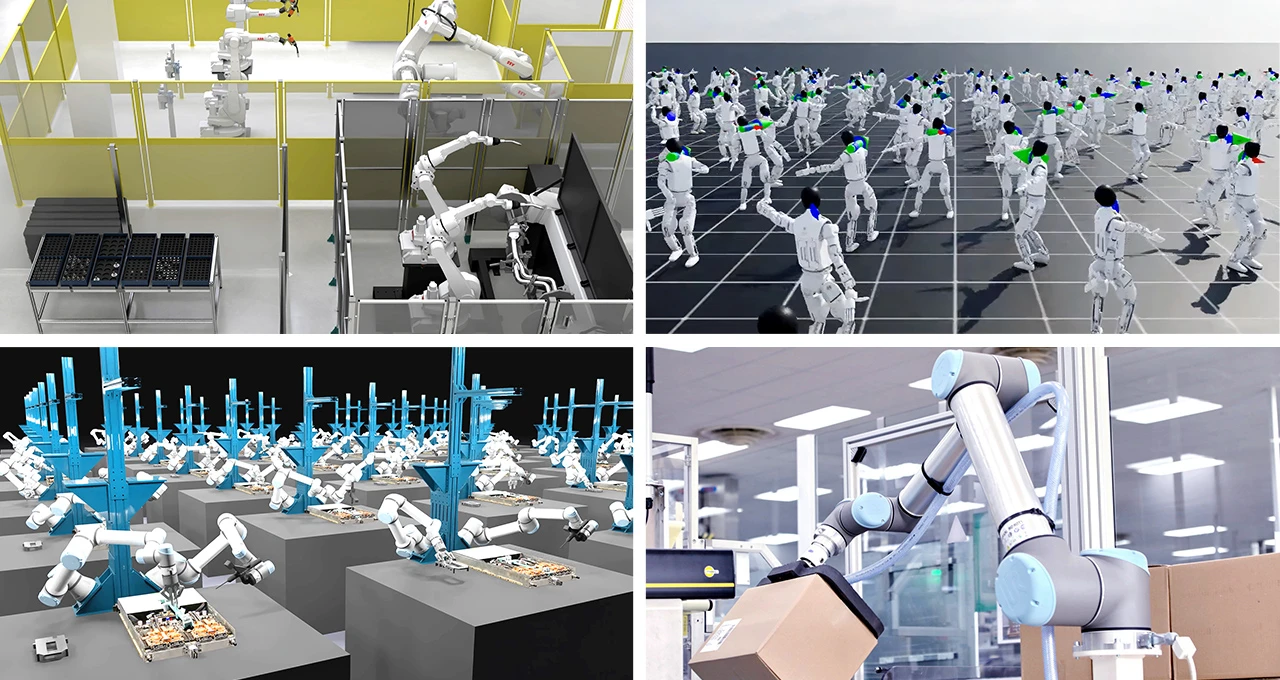
As industrial robotics becomes increasingly driven by AI, manufacturers require highly accurate, high-fidelity simulations to design, test, and optimize systems before deployment.
With a global installed base of more than 2 million robots, FANUC, ABB Robotics, YASKAWA, and KUKA are incorporating NVIDIA Omniverse™ libraries and NVIDIA Isaac simulation frameworks into their virtual commissioning solutions. This enables them to develop and validate complex robotic applications and full production lines using physically accurate digital twins.
Robotics is advancing from task-specific machines to more adaptable, generalist-specialist systems that still deliver the precision and reliability required for industrial applications. To reach this level, robots must develop humanlike reasoning, along with the ability to perceive, make decisions, and act autonomously.
Leading developers such as FieldAI and Skild AI are creating generalized robot “brains” using NVIDIA Cosmos world models for data generation, alongside Isaac simulation frameworks to test and validate policies in virtual environments—allowing robots to learn new tasks with minimal retraining. World Labs is leveraging Isaac Sim™ to validate its generative world models, while Generalist AI is utilizing Cosmos to explore synthetic data generation.
Developing humanoid robots remains one of the most complex challenges in robotics, as replicating human mobility, dexterity, and reasoning requires the seamless integration of advanced AI, perception, and real-time control into systems that are safe, reliable, and autonomous.
Industry leaders such as 1X, AGIBOT, Agility, Agile Robots, Boston Dynamics, Figure, Hexagon Robotics, Humanoid, Mentee, and NEURA Robotics are leveraging NVIDIA Cosmos world models, along with Isaac Sim and Isaac Lab, to accelerate the development and validation of next-generation humanoid robots.
NVIDIA has also introduced Isaac Lab 3.0 in early access, enabling faster, large-scale robot learning on NVIDIA DGX™-class infrastructure. Built on the new Newton physics engine 1.0 and the NVIDIA PhysX® SDK, it brings multiphysics simulation capabilities and enhanced support for complex, dexterous manipulation.
In parallel, AGIBOT, Humanoid, LG Electronics, NEURA Robotics, and Noble Machines are adopting NVIDIA Isaac GR00T N models to accelerate industrial deployment of humanoid systems. NVIDIA announced that GR00T N1.7 is now available in early access with commercial licensing, offering advanced, generalized robot skills—including sophisticated dexterous control—for production-ready applications.
During his GTC keynote, Huang also previewed GR00T N2, a next-generation robot foundation model based on DreamZero research. Built on a new world action model architecture, it enables robots to successfully perform new tasks in unfamiliar environments at more than twice the rate of leading vision-language-action models. Scheduled for release by the end of the year, GR00T N2 currently ranks first on MolmoSpaces and RoboArena for generalist robot policies.
Healthcare represents a major opportunity for physical AI, but deploying autonomous systems across areas such as surgery, imaging, and hospital operations requires infrastructure that meets the highest standards of safety and regulatory compliance.
By building an open, integrated platform for designing, training, testing, and deploying physical AI, NVIDIA is driving collaboration across the robotics ecosystem—an essential step toward scaling real-world deployment.
These strategic partnerships are already translating platform integration into tangible industry impact.
Skild AI is collaborating with ABB Robotics and Universal Robots to deploy its generalized robot intelligence across a range of industries and applications. By embedding a shared intelligence layer into widely used industrial and collaborative robots, manufacturers can expand automation into more dynamic and variable workflows without developing task-specific code. At the same time, Skild AI is working with Foxconn on high-precision assembly for NVIDIA Blackwell production lines, enabling AI-powered dual-arm manipulators to handle some of the most complex manufacturing tasks.
Lightwheel is co-developing and calibrating the Newton physics engine to support Samsung’s assembly robots, particularly in mastering intricate cable handling in simulation, resulting in improved precision and faster production lines.
PTC has introduced a new design-to-simulation workflow that connects its cloud-native Onshape CAD and product data management platform with NVIDIA Isaac Sim. This seamless CAD-to-OpenUSD integration enables companies such as FANUC America Corporation and Fauna Robotics to design and validate robotic systems within highly accurate digital twins.
WORKR is integrating its AI platform with ABB Robotics systems, leveraging NVIDIA Omniverse libraries within its WorkrCore to train robotic workforces that can be deployed by small- and medium-sized manufacturers within minutes—without requiring programming expertise.
KION Group is partnering with NVIDIA and Accenture to advance autonomous warehouse solutions. Using Omniverse and a physical AI-powered digital twin architecture developed with Accenture, KION engineers can build large-scale, physics-accurate warehouse simulations to train and test fleets of NVIDIA Jetson-powered autonomous forklifts for GXO.
Meanwhile, Microsoft Azure and Nebius are integrating the NVIDIA Physical AI Data Factory blueprint to enable scalable, agent-driven synthetic data generation for developers, including FieldAI, Teradyne Robotics, Hexagon Robotics on Azure, and RoboForce on Nebius. CoreWeave is incorporating NVIDIA Isaac Lab to develop robot learning pipelines, while Alibaba Cloud is integrating NVIDIA’s full physical AI stack into its Platform for AI to accelerate end-to-end robotics development.
NVIDIA is committed to making physical AI tools accessible to innovators at every level—from early-stage startups to the global open-source community.
Through its NVIDIA Inception program, a global startup incubator with more than 40,000 members, the company offers robotics innovators a dedicated gateway to its open physical AI stack. Inception members such as Bedrock Robotics, Dexterity AI, Flexion, Lightwheel, RIVR, Standard Bots, Vention, and World Labs benefit from technical support, high-performance computing resources, and access to key partners and customers across the robotics ecosystem.
NVIDIA has also partnered with Hugging Face to integrate Isaac and GR00T into the LeRobot open-source framework, linking NVIDIA’s community of over 2 million robotics developers with Hugging Face’s 13 million AI builders worldwide to accelerate open-source robotics innovation.