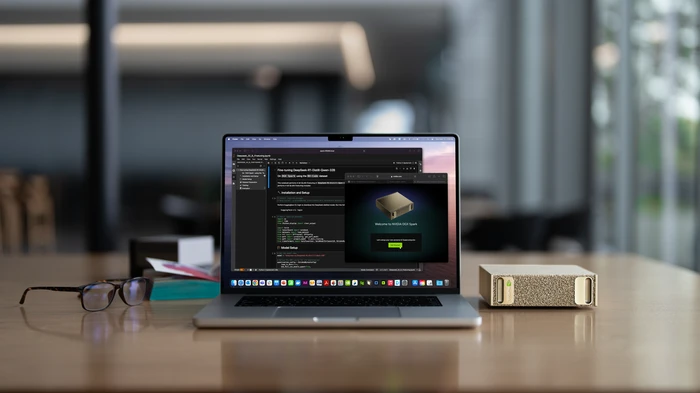
NVIDIA has announced the upcoming shipment of NVIDIA DGX Spark™, the world’s smallest AI supercomputer.
As AI workloads continue to exceed the memory and software limits of traditional PCs, workstations, and laptops, many developers have been forced to move their projects to the cloud or local data centers.
DGX Spark introduces a new class of computing — delivering a petaflop of AI performance and 128GB of unified memory in a compact desktop design. This enables developers to perform inference on AI models with up to 200 billion parameters and fine-tune models with up to 70 billion parameters locally. Additionally, DGX Spark allows developers to build AI agents and run sophisticated software stacks directly on their desktops.
“In 2016, we built DGX-1 to give AI researchers their own supercomputer. I hand-delivered the first system to Elon at a small startup called OpenAI — and from it came ChatGPT, kickstarting the AI revolution,” said Jensen Huang, founder and CEO of NVIDIA. “DGX-1 launched the era of AI supercomputers and unlocked the scaling laws that drive modern AI. With DGX Spark, we return to that mission — placing an AI computer in the hands of every developer to ignite the next wave of breakthroughs.”
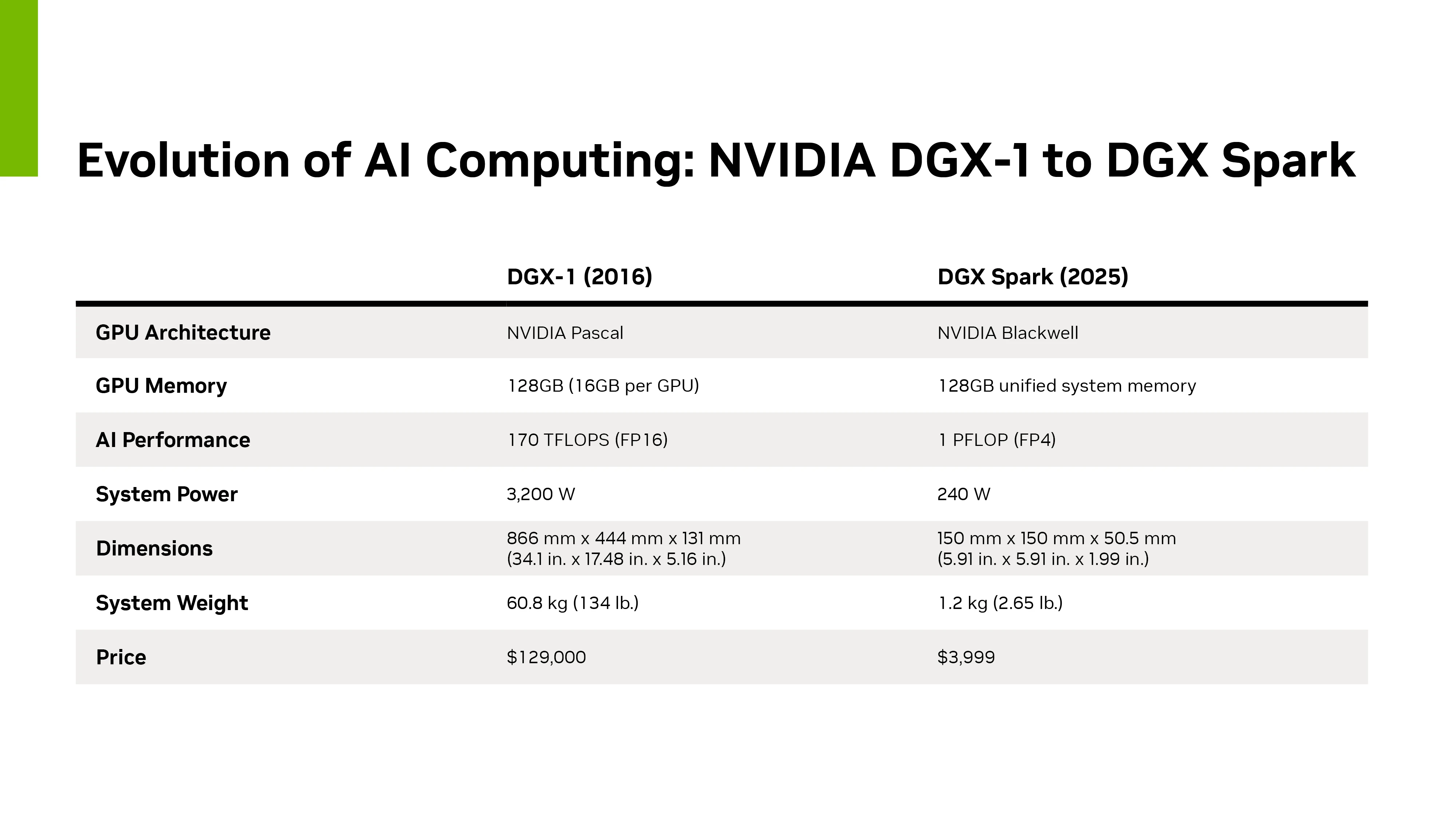
DGX Spark unites the entire NVIDIA AI platform — GPUs, CPUs, networking, CUDA® libraries, and the NVIDIA AI software stack — in a system small enough for a lab or office, yet powerful enough to drive advanced agentic and physical AI development. Combining breakthrough performance with the vast NVIDIA ecosystem, DGX Spark transforms the traditional desktop into a full-fledged AI development powerhouse.
Each DGX Spark system delivers up to 1 petaflop of AI performance, powered by the NVIDIA GB10 Grace Blackwell Superchip, NVIDIA ConnectX®-7 200 Gb/s networking, and NVIDIA NVLink™-C2C technology, which provides five times the bandwidth of PCIe Gen 5 and enables 128GB of unified CPU-GPU coherent memory.
Preinstalled with the NVIDIA AI software stack, DGX Spark lets developers begin working immediately. Users can access NVIDIA’s extensive AI ecosystem, including pre-trained models, libraries, and NVIDIA NIM™ microservices, enabling local workflows such as refining image generation with Black Forest Labs’ FLUX.1 models, building vision-based agents using NVIDIA Cosmos™ Reason vision-language models, or creating optimized chatbots based on Qwen3 for DGX Spark.
To mark the global launch, NVIDIA CEO Jensen Huang personally delivered one of the first DGX Spark units to Elon Musk, chief engineer at SpaceX, at Starbase, Texas — a symbolic moment linking back to 2016, when Musk’s team received the first NVIDIA DGX™-1 supercomputer.
Other early adopters — including Anaconda, Cadence, ComfyUI, Docker, Google, Hugging Face, JetBrains, LM Studio, Meta, Microsoft, Ollama, and Roboflow — are already testing, validating, and optimizing their tools and models for DGX Spark.
Leading research institutions such as the NYU Global AI Frontier Lab have also previewed DGX Spark to accelerate their AI development and experimentation.
“DGX Spark allows us to access peta-scale computing on our desktop,” said Kyunghyun Cho, professor of computer and data science at the NYU Global AI Frontier Lab. “This new way to conduct AI research and development enables us to rapidly prototype and experiment with advanced AI algorithms and models — even for privacy- and security-sensitive applications, such as healthcare.”