KUKA unveils vision for Automation 2.0 as Physical AI reshapes global manufacturing

An orange robot from KUKA took the stage at NVIDIA GTC, joining Jensen Huang, the founder and CEO of NVIDIA—the world’s most valuable publicly listed company. His keynote underscored a clear message: industrial automation is moving into a new era. In the manufacturing sector, AI will go beyond analysis and prediction to actively perceive, make decisions, and operate autonomously in the physical environment.
Physical AI and next-generation robotics are quickly becoming essential across manufacturing, supply chains, and industrial services, helping drive greater productivity and competitiveness. This shift is being fueled by advances in large-scale AI models, simulation-based innovation, and high-performance computing architectures that span devices, edge systems, and data centers.
KUKA Group, as a global automation company, is playing an important role in this shift. KUKA Group CEO Christoph Schell says: “Robots and automation systems are evolving from programmable machines to intelligent collaborators, capable of learning, adapting and operating safely alongside humans. With new open software platforms such as KUKA AMP bridging traditional deterministic automation, such as rule‑based, pre‑programmed systems, with intent-based automation, the pathway from concept to deployment is becoming faster, more accurate, more cost efficient and more autonomous”. KUKA unveiled its new automation management software platform (KUKA AMP) publicly for the first time at NVIDIA GTC.
From Automation 1.0 to Physical AI: KUKA Group builds on its strengths to drive global leadership and future growth
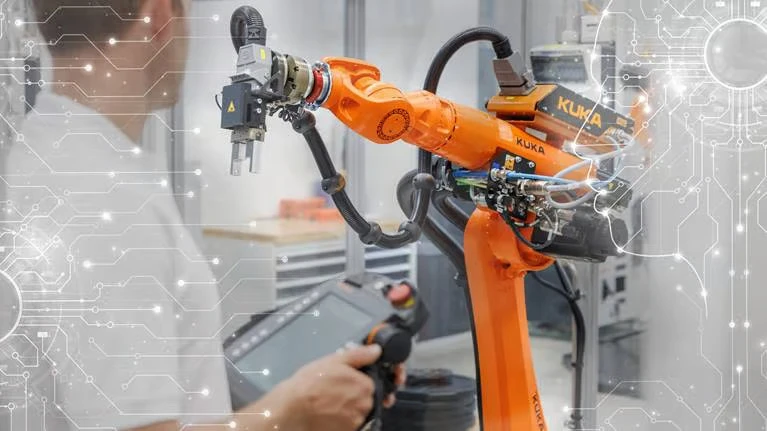
Robots are evolving from programmable machines into intelligent collaborators, capable of learning, adapting and operating safely alongside humans. © KUKA Group.
Meanwhile, within the current landscape of traditional rule-based systems—often referred to as “Automation 1.0”—competition is intensifying. Established automation clients, particularly in the automotive sector and other industries, are scaling back investments, while demand patterns and manufacturing operations continue to shift across global markets. “As we move toward Automation 2.0 and Physical AI, Automation 1.0 remains essential – for KUKA and for the entire industry. Proven, rule-based automation continues to deliver the stability and productivity our customers rely on, especially in high volume and safety critical environments. We’re not replacing it. We’re expanding it with intent-based and AI driven capabilities. Automation 1.0 remains as the backbone, while Automation 2.0 adds new flexibility. KUKA will continue to be a key player in both”, Christoph Schell says.
KUKA Group accelerates innovation with record R&D spend and a billion euro milestone in China
In 2025, KUKA invested a record €213 million in research and development—the highest level in its history. The company has also achieved a more balanced global presence, with revenue distributed تقريبately evenly across EMEA (Europe, the Middle East, and Africa), the Americas, and Asia-Pacific, each contributing about one-third.
"Automation 1.0 remains as the backbone, while Automation 2.0 adds new flexibility. KUKA will continue to be a key player in both."
- Christoph Schell, CEO KUKA Group
Global expansion with innovation hubs and integrated automation solutions across Asia
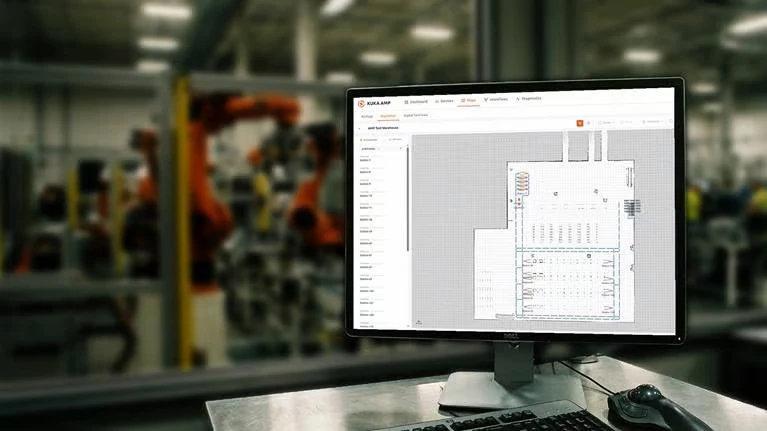
KUKA Group, known for its profound manufacturing expertise, is transforming from a machine manufacturer into a physical AI company. © KUKA Group.
For customers, this means working with a single automation partner capable of integrating hardware, software, and digital solutions—ranging from industrial and mobile robotics to simulation, shuttles, cranes, warehouse systems, and healthcare automation. KUKA delivers seamless, end-to-end automation solutions that are easier to implement, scale, and manage globally.