From the factory floor to the living room: 22 mobile robots keep TV production running
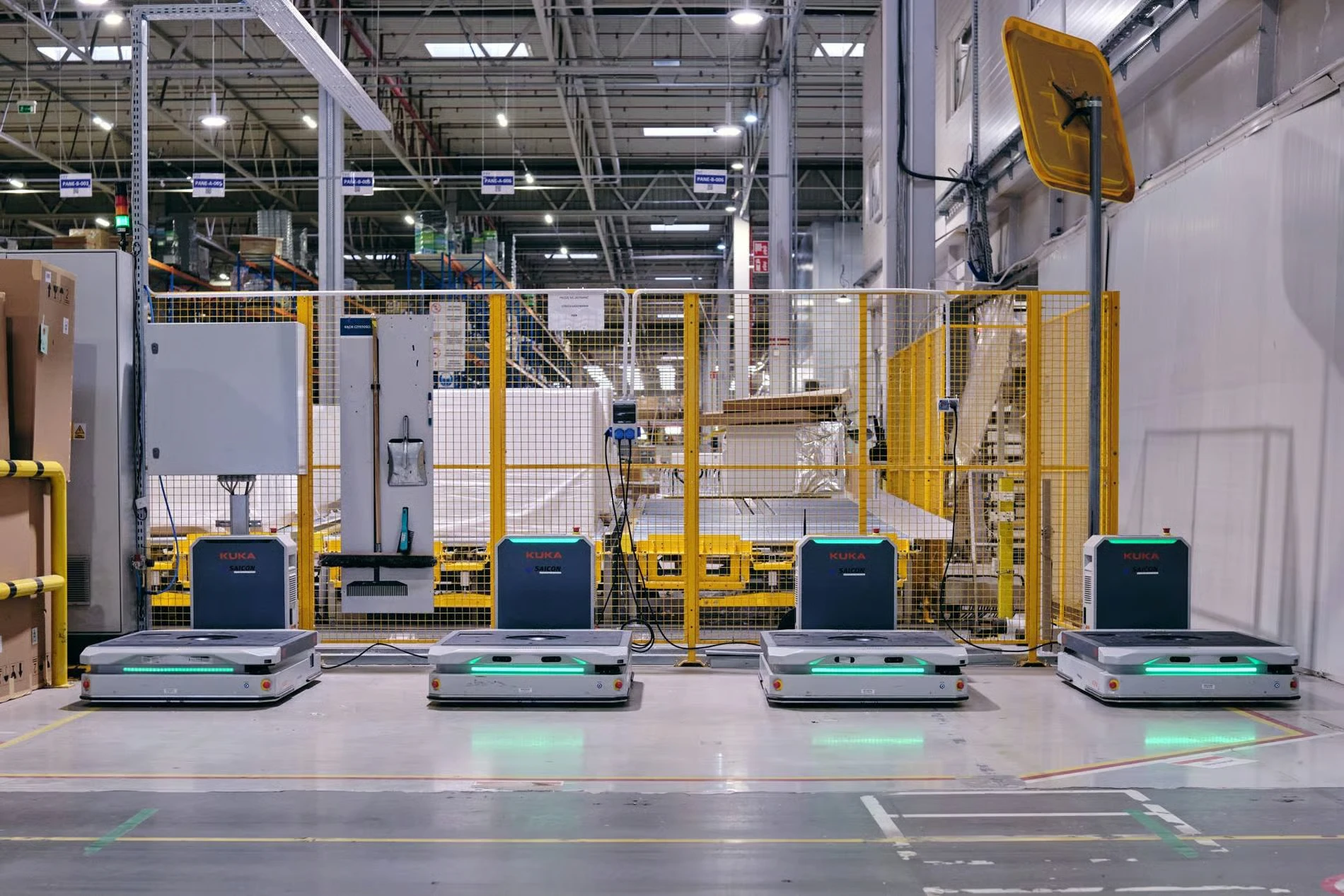
Operations at the production facility of a leading European television manufacturer have been significantly modernized with the deployment of autonomous mobile robots from KUKA. At the company's plant in Gorzów Wielkopolski, Poland, a fleet of 22 self-driving robots now handles the continuous transport of materials between the warehouse and production lines, replacing the need for employees to manually operate electric carts. Operating around the clock, the autonomous system improves the efficiency, reliability, and consistency of internal material handling.
Automation brings stability to production
TPV Displays Polska, one of Europe's leading television manufacturers, has further advanced its production operations by automating internal material transport. While industrial robots have long been integrated into its manufacturing processes, the movement of materials between production areas previously relied on manual labor. Employees used electric carts to transport television panels and components throughout the facility, making the process both time-consuming and physically demanding.
The manual approach also resulted in inconsistent material flow, limited production flexibility, and greater challenges in planning and adapting logistics to changing manufacturing requirements. By automating internal transport, the company aims to improve operational efficiency, optimize material flow, and better support evolving production demands.
"The combination of stationary robots and AMRs improves the efficiency of supply to assembly lines, increases flexibility, and integrates material flow and storage into a high-performance integrated system."
- Grzegorz Benda, Technischer Direktor at TPV Displays Polska
Automated material transport with autonomous robots
The introduction of 22 autonomous mobile robots has fully automated internal material transport at the facility. Operating independently throughout the production environment, the self-driving robots transport television panels and components from the warehouse to ten assembly lines, return empty packaging, and continuously optimize their routes to improve efficiency. Designed to operate safely alongside employees, the autonomous robots take over physically demanding transportation tasks, reducing manual workloads while enhancing the speed, reliability, and efficiency of material handling across the production facility.
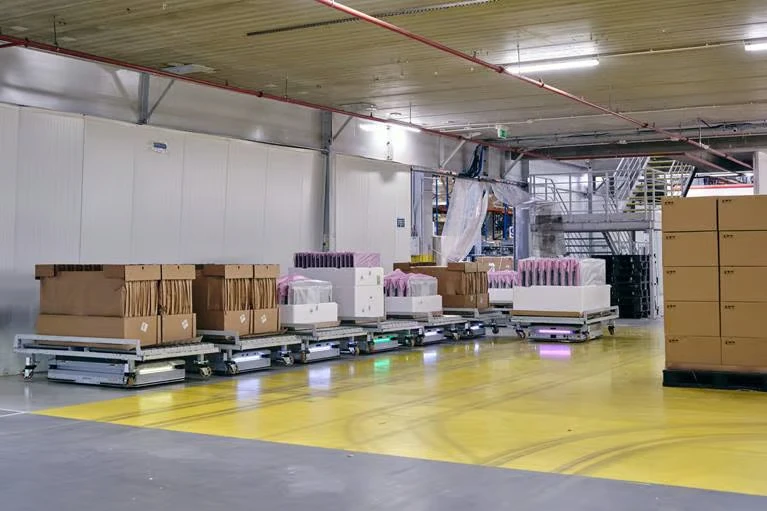
A coordinated interaction between robots
Smart software ensures predictable processes
The integration of the autonomous mobile robots was implemented by automation specialist Saicon. A centralized software platform manages the entire fleet, assigning transport tasks, monitoring operations in real time, and optimizing both routing and robot utilization.
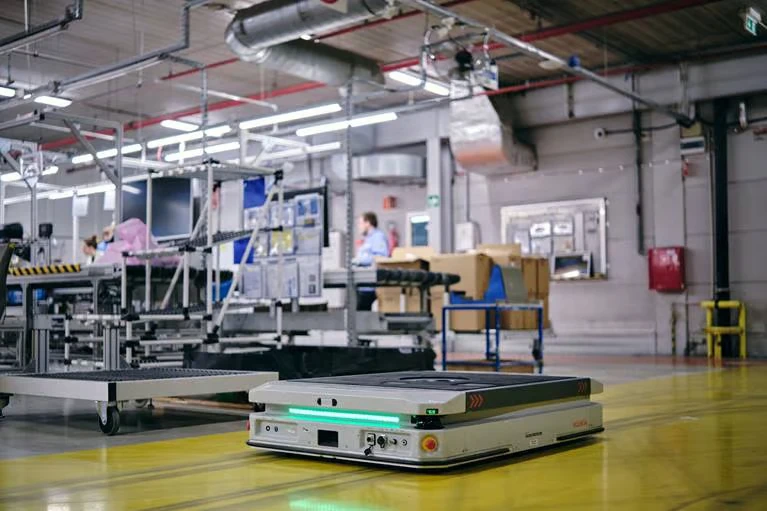
Greater transparency and future readiness
The status of the entire robot fleet can be continuously monitored, allowing full visibility of operations at all times. The data collected by the system is used to analyze workflows, identify optimization opportunities, and support ongoing improvements in operational efficiency. At the same time, the platform is designed with flexibility in mind, enabling it to adapt to future production requirements and evolving operational needs within the facility.
From KUKA’s perspective, the project also demonstrates the potential of this technology: “This implementation demonstrates that autonomous mobile robots are already increasing production stability today - through reliable processes, greater transparency in material flow, and better management of intralogistics complexity”, says Mateusz Nowakowski, AMR Business Developer at KUKA Polska.
This underlines how automated material transport helps companies make their production processes more stable, efficient, and future‑proof.