Boston Dynamics & FieldAI Partner to Bring Robots Into Uncharted, Dynamic Environments
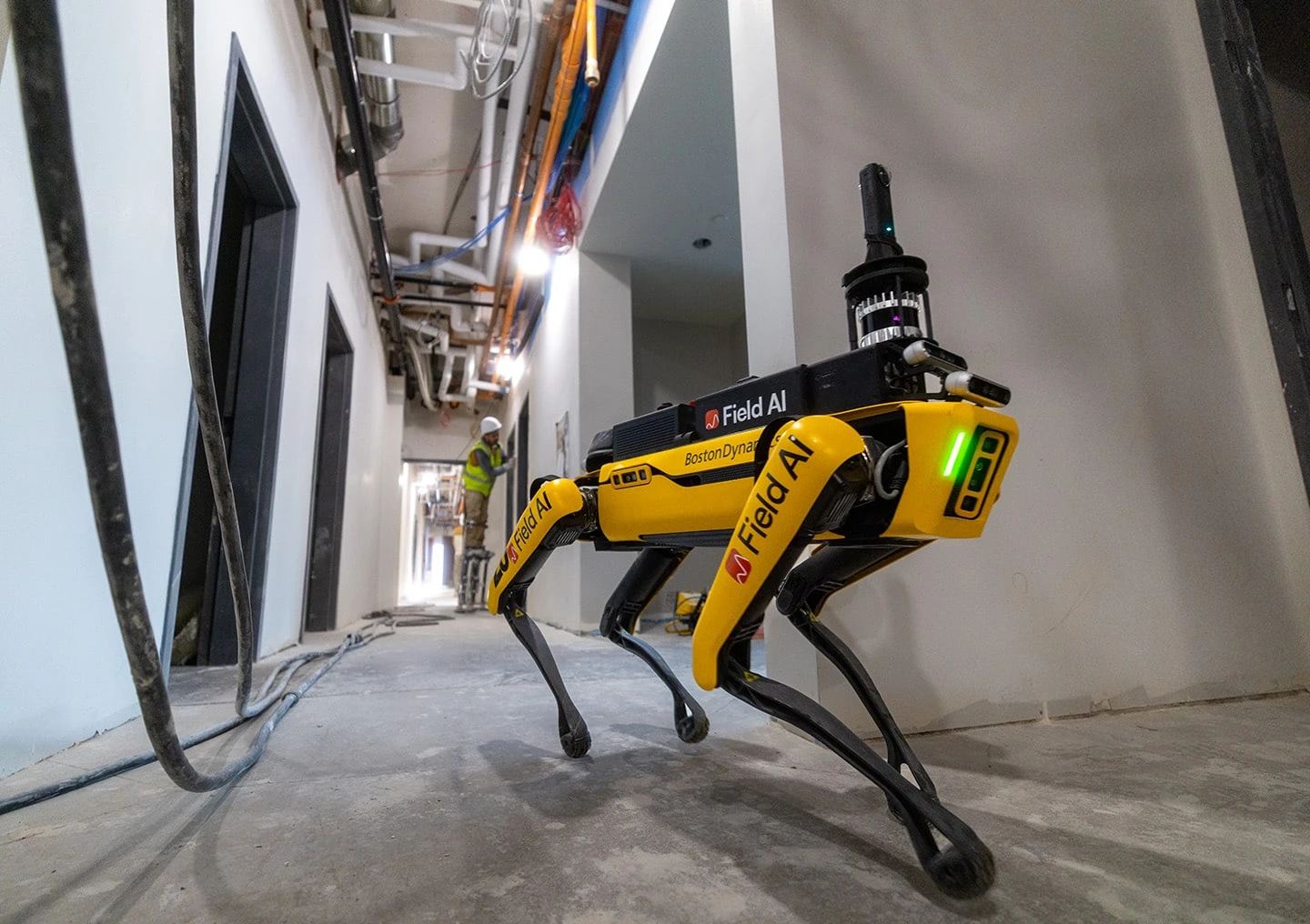
Boston Dynamics and FieldAI have announced a new partnership aimed at advancing robotics in construction and other complex, rapidly changing environments. The collaboration brings together Boston Dynamics’ advanced robotic platforms and software ecosystem with FieldAI’s Field Foundation Models™ (FFMs), enabling robots to explore and operate autonomously in environments that have traditionally been considered too unpredictable for robotic systems.
Construction sites provide a key example of such environments. These locations are constantly evolving, with shifting terrain, changing layouts, and ongoing human activity. Such dynamic conditions have historically made it difficult for conventionally programmed robots to function safely and effectively. At the same time, collecting accurate and timely data while maintaining oversight of fast-moving projects often requires significant manual effort, increases the risk of human error, and can expose workers to potentially hazardous situations.
For this reason, the construction industry is being used as a proving ground for the technology. If robots can successfully operate autonomously in these challenging conditions, the same capabilities could be applied across a wide range of other industries and environments.
“We’ve known Ali and his team since they won the Urban-circuit of the DARPA Subterranean Challenge using Spot robots, while tackling similar challenges for NASA,” said Marc Raibert, Founder of Boston Dynamics. “Combining Field AI’s expertise in risk-aware autonomy with Spot’s remarkable mobility allows us to tackle uncharted and highly dynamic environments together—spaces that were previously off-limits to robots. This is truly great progress for robotics, and we are excited by the challenges FieldAI is taking on.”
Boston Dynamics leverages its extensive experience in deploying autonomous robots in industrial environments to address these challenges. Its robotic platforms are built to operate reliably in manufacturing and process facilities around the clock, effectively becoming a constant presence within these environments. The robots carry out scheduled missions and collect thousands of data points, which are analyzed through the Boston Dynamics Orbit™ platform. This enables organizations to identify potential equipment failures early, perform preventive maintenance, and conduct routine security inspections.
Through its partnership with FieldAI, a leader in robotic artificial intelligence and autonomous operations, Boston Dynamics’ robots are entering a new phase of general-purpose autonomy. At the center of FieldAI’s technology is the Field Foundation Model™ (FFM), a new category of “physics-first” foundation model designed specifically for embodied intelligence. This technology provides a foundational layer that enables coordinated operations among multiple robots operating as a fleet.
Unlike traditional AI systems adapted for robotics, FFMs are purpose-built to reason about uncertainty, risk, and the physical constraints of real-world environments. This allows robots to safely and autonomously navigate dynamic, unstructured settings—even when encountering situations they have not previously been trained to handle. Importantly, these robots can operate without relying on pre-mapped environments, GPS signals, fixed routes, or additional infrastructure. Powered by FieldAI’s FFMs, the robots are capable of fully on-device operation without requiring a cloud connection, enabling deployment in remote and challenging locations around the world.
FieldAI + Spot: A Construction-Focused Autonomy Solution
The integration of Boston Dynamics’ Spot®, a quadruped robot designed for industrial inspection and mobility in complex environments, with FieldAI’s Field Foundation Models™ significantly expands its capabilities. With this technology, Spot can better understand construction sites and monitor as-built progress in real time. Spot’s robust mobility combined with FFM’s risk-aware decision-making allows it to safely navigate environments that were previously considered too unpredictable for automation.
As robots gather operational data from diverse sites, FieldAI’s models continuously improve, creating a growing data advantage that enhances reliability and supports faster deployment at scale.
This solution addresses several major challenges in the construction industry, including unpredictable terrain, constantly evolving workflows, and safety monitoring requirements. FFMs allow Spot to adapt to changes in site conditions, capture accurate data, and align this information with digital twin or BIM models—transforming raw data into actionable insights.
With its ability to explore uncharted environments, a FieldAI-powered Spot can navigate unknown or rapidly changing areas without prior environmental knowledge. These include underground mines, evolving construction zones, or busy human-populated sites.
“FieldAI is leading the way in scaling deployments in complex and dynamic job sites worldwide, delivering real value for construction teams,” said Marc Theermann, Chief Strategy Officer at Boston Dynamics. “Making robots operate reliably in these environments and handle uncharted exploration is incredibly challenging, and if any team can tackle it, it’s FieldAI.”
Deployed across multiple construction sites, Spot equipped with FFMs can autonomously perform inspections, mapping, and monitoring tasks. It tracks daily progress through 3D scans and images, identifies potential hazards such as standing water or blocked exit routes, and can operate overnight to deliver updated insights each morning.
A key advantage of FieldAI’s approach is its focus on managing fleets of robots operating simultaneously as a coordinated multiagent system. This enables robots to collaborate, share environmental understanding, and collectively analyze site conditions at scale. Instead of functioning as individual tools, the robots operate as a distributed system capable of supporting large-scale operations.
Such robotic fleets can also be deployed across multiple projects, enabling standardized workflows and consistent data collection across construction operations.
The FieldAI–Boston Dynamics partnership has already demonstrated measurable benefits for construction projects:
- Efficiency: Inspection and documentation time reduced by more than 90% compared with manual processes.
- Cost Savings: Early identification of project deviations helps reduce expensive rework.
- Safety: Robots monitor hazardous areas, minimizing worker exposure to risks.
- Scalability: Customers across Asia, Europe, and North America are expanding deployments to enterprise-scale operations.
“Complex real-world sites, such as construction sites, are unpredictable by nature,” said Ali Agha, Founder and CEO of FieldAI. “The real breakthrough is developing robots and robot brains that understand risk and make decisions in real time. That kind of intelligence allows robots to adapt on their own, bringing a new level of reliability and insight to complex environments. We’re now at the inflection point where large fleet-scale deployment becomes possible.”
As part of the partnership, FieldAI plans to expand the deployment of the Spot robot in the coming months, building one of the largest third-party fleets of quadruped robots in the world. The integration of Boston Dynamics’ Spot with FieldAI’s Field Foundation Model (FFM) demonstrates how this approach can be extended to other industries where adaptability, reliability, and safety are essential. By advancing and refining this technology within the construction sector, the companies aim to push the boundaries of embodied AI and pave the way for broader autonomous applications in the future.