ABB Robotics survey shows acceleration in automation investment for automotive manufacturers
“The intelligent factory is no longer a future ambition – it has become essential for manufacturers looking to stay competitive in a challenging and fast-moving environment,” said Joerg Reger, Managing Director of ABB Robotics Automotive Business Line. “This year’s survey shows that automation, particularly more autonomous and versatile robotics (AVRTM), are increasingly viewed as a practical, near-term solution to cost pressures, labor availability and energy efficiency challenges.”
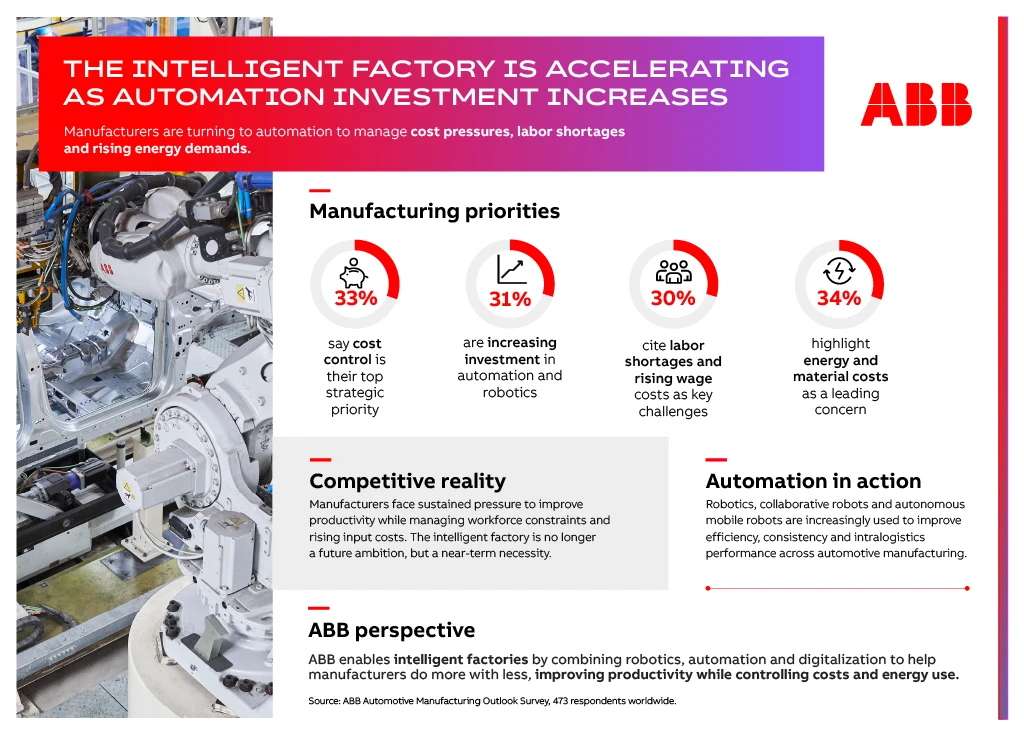
Workforce challenges remain a significant concern. Around 30% of respondents identified labor shortages and rising wage costs as key issues, while limited access to skilled workers continues to restrict production planning and operational flexibility in many regions.
At the same time, energy and material costs are a major pressure point, cited by 34% of manufacturers. This underscores the need for more efficient production processes and smarter use of resources across factory operations.
In response, manufacturers are increasingly adopting robotics, automation and autonomous material-handling solutions to improve productivity, efficiency and resilience. Nearly one-third of respondents (31%) highlighted increased investment in automation and robotics as a key strategy for the year ahead, emphasizing the role of intelligent automation in addressing multiple challenges at once.
The survey also points to growing adoption of a wider range of automation technologies. Collaborative robots (cobots) are well suited for repetitive and time-intensive assembly tasks, working safely alongside human operators to enhance consistency and throughput.
At the same time, autonomous mobile robots (AMRs) and automated guided vehicles (AGVs) are gaining traction for their ability to transport parts and materials more safely and efficiently, reducing manual handling and improving intralogistics.
“Manufacturers are investing more selectively and more intelligently in automation,” added Reger. “Energy-efficient robots, flexible automation cells, cobots and autonomous mobile robots all play a role in helping factories do more with less – increasing productivity while keeping costs and energy consumption under control."